4TRK
What it is
Section titled “What it is”4TRK is, in its author’s own description, “a compact desktop music workstation inspired by trackers, grooveboxes, samplers, and retro computer energy.” It carries 8 drum channels with per-step rolls, probability, pitch, flam, and pan, plus 3 flexible tracks that can be configured as polyphonic synth voices (subtractive, dual-oscillator, wavetable, FM, additive, SFZ, SoundFont, or sample-based) or as plain audio tracks. Built-in effects include saturation, warble, hiss, delay, reverb, and filter — tape-emulation effects sit alongside the modern DAW effects. It ships with many themes and a theme editor, two screen resolutions (studio 640 at 640px or classic 320 at 320px, switchable in settings), and a deep CRT-effects layer (“a bunch of CRT effects and theming tweaks”).
Of every reference in the entire three-batch inspiration corpus, 4TRK is the single strongest aesthetic match for KN-86’s Deckline identity — the visual language, the deliberate retro-resolution constraint, the named-themes-with-editor model, and the CRT effects all point at the same place KN-86 is going.
Aesthetic / design inspiration for KN-86
Section titled “Aesthetic / design inspiration for KN-86”- The compact-music-workstation silhouette as KN-86’s silhouette inspiration. 4TRK reads, in its screenshots, as if it could be sitting alongside a TR-808 and a 4-track cassette recorder on a producer’s desk. KN-86’s Deckline identity should land at the same place: not a laptop, not a calculator, not a game console — a dedicated working instrument that happens to be a terminal. The tracker / groovebox lineage is the right family.
- Dual-resolution mode (
studio 640vsclassic 320) is a direct architectural reference. 4TRK ships two logical canvas sizes the user can switch between in settings. KN-86 is committed to a single canonical 1024×600 / 80×25 grid (per Canonical Hardware Specification, locked), so this isn’t directly portable — but the idea of carrying a “studio” vs “classic” mode resonates. The closest read-across for KN-86 is the planned glyph-treatment toggle in ADR-0014 F1 (Press Start 2P at 1×2 scaled vs native 12×24), which is exactly the same kind of “high-detail studio mode vs chunky classic mode” toggle. 4TRK is the precedent. - Theme editor as an in-product affordance. Not just select a theme, but edit a theme. The pattern matches the OS Models color-picker UI directly — 4TRK extends that into a built-in editor for named themes. For KN-86: when the aesthetic-mode roster is implemented (v0.2+), the SYS tab should host an aesthetic-mode editor, not just a picker. Users edit their AMBER variant (slightly warmer? slightly cooler? scanlines on? scanlines off?), save it as a named mode, share it as a TOML snippet.
- CRT effects layer. “A bunch of CRT effects and theming tweaks” — scanlines, phosphor bleed, screen curvature, color fringing. KN-86’s emulator can ship a similar layer: aesthetic-mode entries in
nosh-config.tomlshould be able to declarecrt_scanlines = true,crt_phosphor_bleed = 0.3,crt_curvature = "subtle". On the device itself the LCD doesn’t have CRT phosphor to simulate, so this is desktop-emulator-only — but as branding it’s strong, and for cart authoring previews (where the author wants to see what the cart looks like on a “device” without actually having one) it’s the right answer. - Tape-emulation FX (saturation, warble, hiss). 4TRK’s effects layer includes deliberate tape artifacts. For KN-86 the parallel isn’t audio effects (the PSG output is the device’s own audio, not running through emulated tape), but the same commitment to deliberate retro mediation — the CIPHER-LINE ticker’s animation profile, the boot sequence, the failure-state prose voice should all carry the same “deliberately mediated by retro hardware” feel. Mood-board citation, not feature port.
- Step sequencer + probability + flam as KN-86 cart pattern. 4TRK’s per-step rolls, probability, pitch, flam, pan is the canonical groovebox step-sequencer model. Any KN-86 music cart (when one ships) should treat this as the IA reference — every step has a probability, a pitch offset, a flam delay. Not v0.1 KN-86, but on the radar for a Toneline cart family (cross-link KN-90T Toneline sister product).
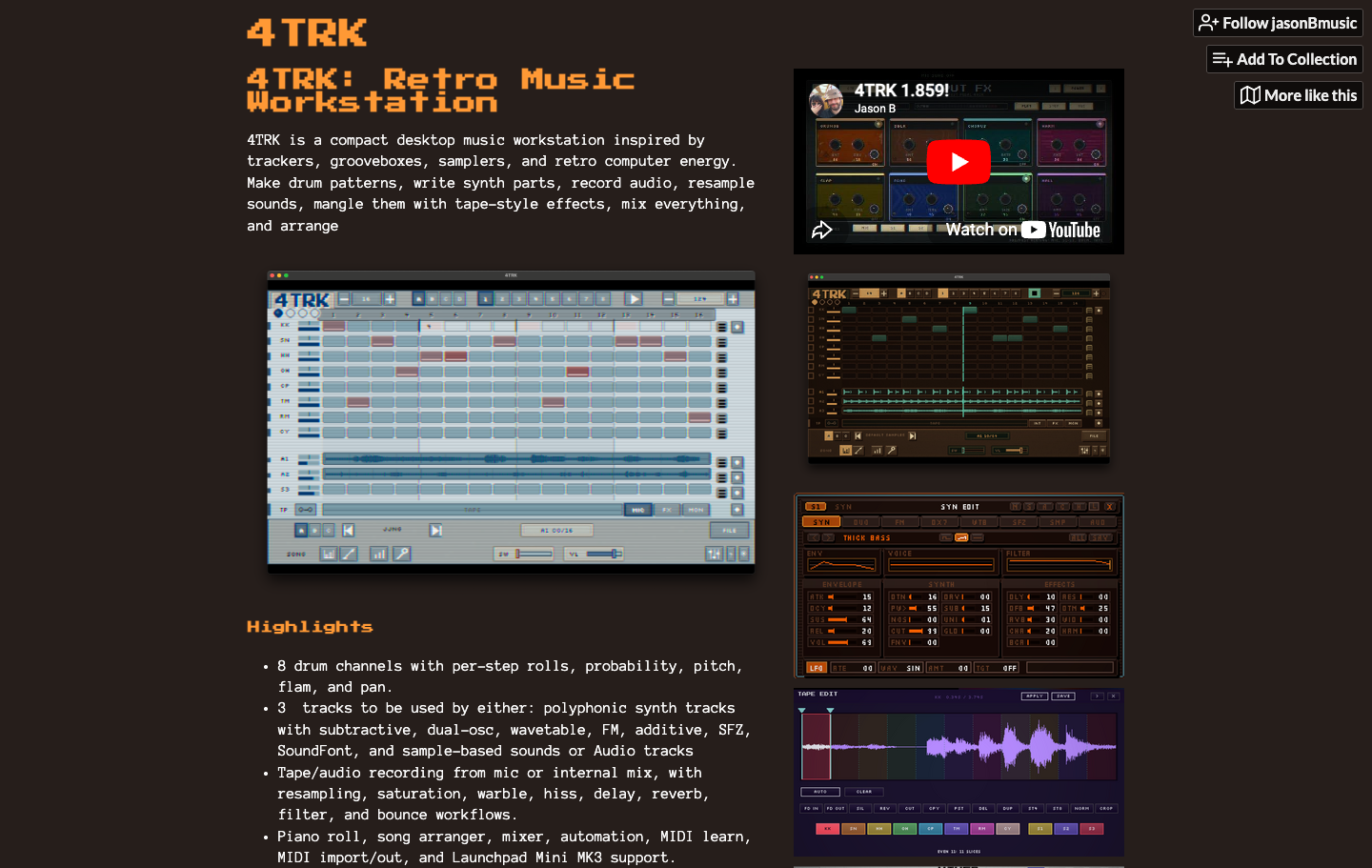
Source: snapshot of jasonbmusic.itch.io/4trk. The page header carries the studio-mode UI screenshot showing the tracker step grid, the synth panels, the FX strip, and the named-theme color palette in motion.
- Direct Batch-3 north-star candidate (see index.md synthesis). The aesthetic alignment is too strong to ignore.
- The author (Jason B Music) ships through itch.io. The KN-86 marketing release plan should treat itch.io’s retro-software-people audience as a meaningful early-access channel — the kind of users who buy 4TRK are the kind of users who would buy a Deckline.
- Cross-link pulsedeck.md — the cassette-deck visual metaphor is in the same family of music-hardware-aesthetic references. PulseDeck commits to cassette specifically; 4TRK commits to tracker / groovebox. KN-86’s Deckline name is broad enough to land in either lineage, but 4TRK’s silhouette is closer to the on-device hardware identity.
- Cross-link x0xb0x.md for the DIY-kit / open-hardware music-instrument lineage; 4TRK is the software analog to x0xb0x’s hardware analog.