Penkesu Computer
What it is
Section titled “What it is”The Penkesu Computer is a homebrew open-source retro handheld built around a Raspberry Pi Zero 2 W, a 7.9″ ultrawide 1280×400 IPS display, a 48-key ortholinear mechanical keyboard with Kailh Choc switches, and a 3D-printed clamshell case hinged with a Game Boy Advance SP-style mechanism. The whole thing reads like a tiny “pencil case” laptop — the name “penkesu” (筆箱) means pencil case in Japanese — and the industrial design leans into off-white restraint rather than maker-fair busyness.
It’s the single most KN-86-adjacent project in this folder: similar processor class (Pi Zero 2 W), similar mechanical-keyboard / Kailh Choc input subsystem (ADR-0018, ADR-0024), open-source hardware, retro handheld silhouette, fixed-envelope display target.
Aesthetic / design inspiration for KN-86
Section titled “Aesthetic / design inspiration for KN-86”- Ultrawide low-height screen as a strong layout cue. The 1280×400 panel is a 3.2:1 aspect — extremely wide, very short. KN-86’s primary display is 1024×600 (~1.7:1), but the experience of a deck-style handheld with most of the action happening across the width (rather than the height) is exactly the framing Penkesu locks in. Worth reading every Penkesu screen layout as a study in horizontal information density — banners, status strips, side-by-side panes. Direct read-across to the KN-86 Row 0 / Rows 1–23 / Row 24 contract: the rows are very wide, you spend the budget across rather than down.
- Clamshell + GBA-SP hinge form. The hinge is borrowed from the GBA SP — chunky, satisfying, with a single hand-snap open/close. KN-86’s Pelican-1170 case is not clamshell (it’s a hard external case with custom 3D-printed inset panels), but the kinesthetic of a deliberate open-the-deck action is the same vibe. Useful to keep in mind when designing the boot sequence and on/off rituals: the device is meant to feel opened, not toggled.
- Ortholinear 48-key keyboard with Kailh Choc switches + MBK keycaps. Identical switch family and keycap profile family to KN-86 (ADR-0024). The Penkesu key plate proves the small-form ortholinear pattern is comfortable and learnable; it’s a useful reference for thumb-cluster ergonomics and palm-rest considerations on the Pelican inset panel.
- Off-white “pencil case” industrial design. Restrained, almost domestic. Reads as a personal artifact, not a piece of tactical gear. KN-86’s design language pulls cyberpunk / dispatch deck harder, but Penkesu is a reminder that retro-handheld silhouette doesn’t require neon-on-black. Useful contrast point when sketching cart shell color/material options (ADR-0019).
- Open-source hardware project hygiene. BOM, STL files, schematics, and a clean parts diagram (see the second image). KN-86 isn’t OSH-licensed (yet?), but Penkesu’s repo is a reference for what “publishable hardware project” looks like: clear gallery, parts breakdown, build guide.
Downloaded image(s)
Section titled “Downloaded image(s)”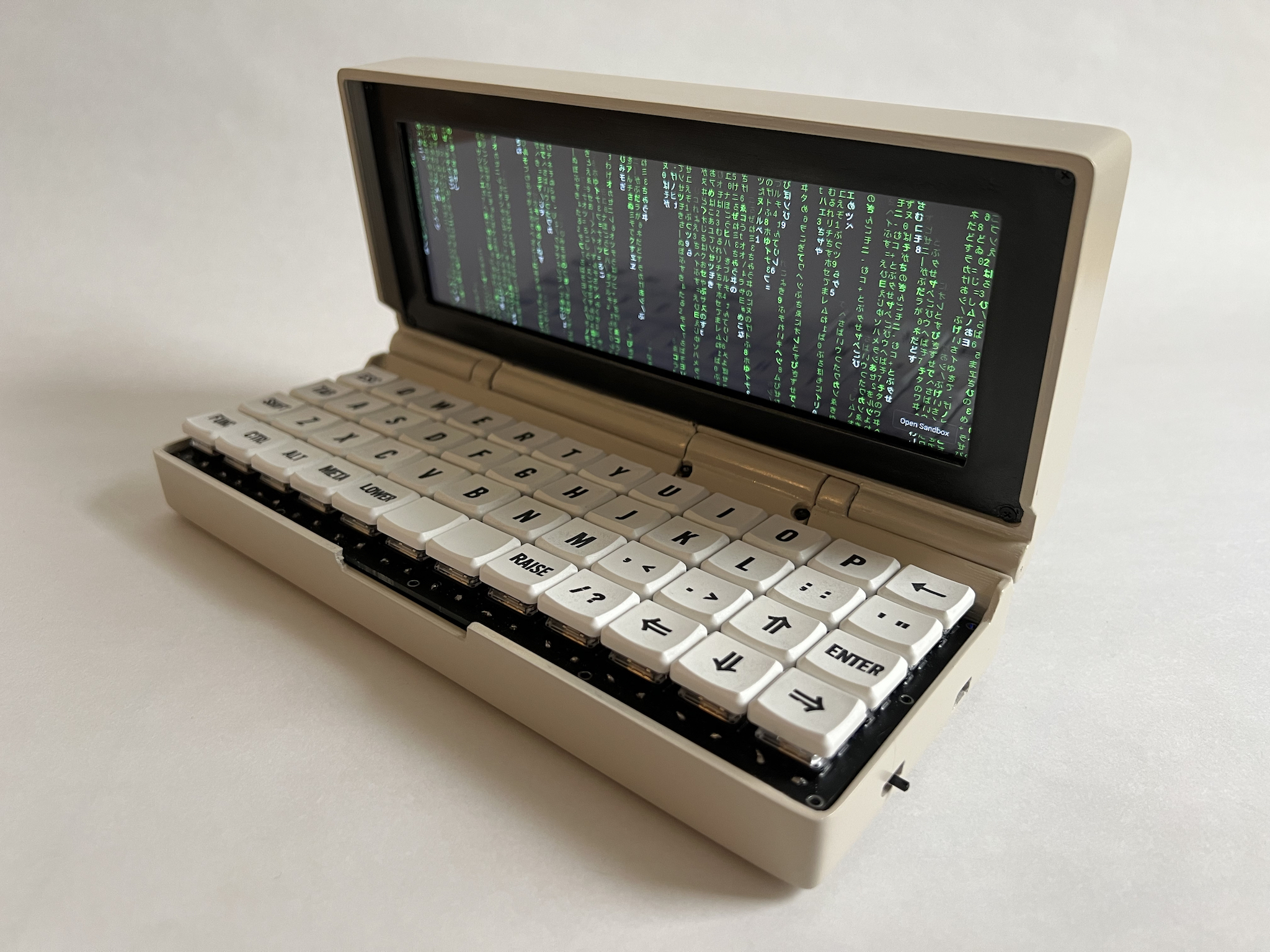
The hero shot is the strongest single visual: open clamshell, ultrawide screen, ortholinear keyboard plate, off-white case. Read this as the form-factor reference for “what a tiny deck looks like in someone’s hands.”
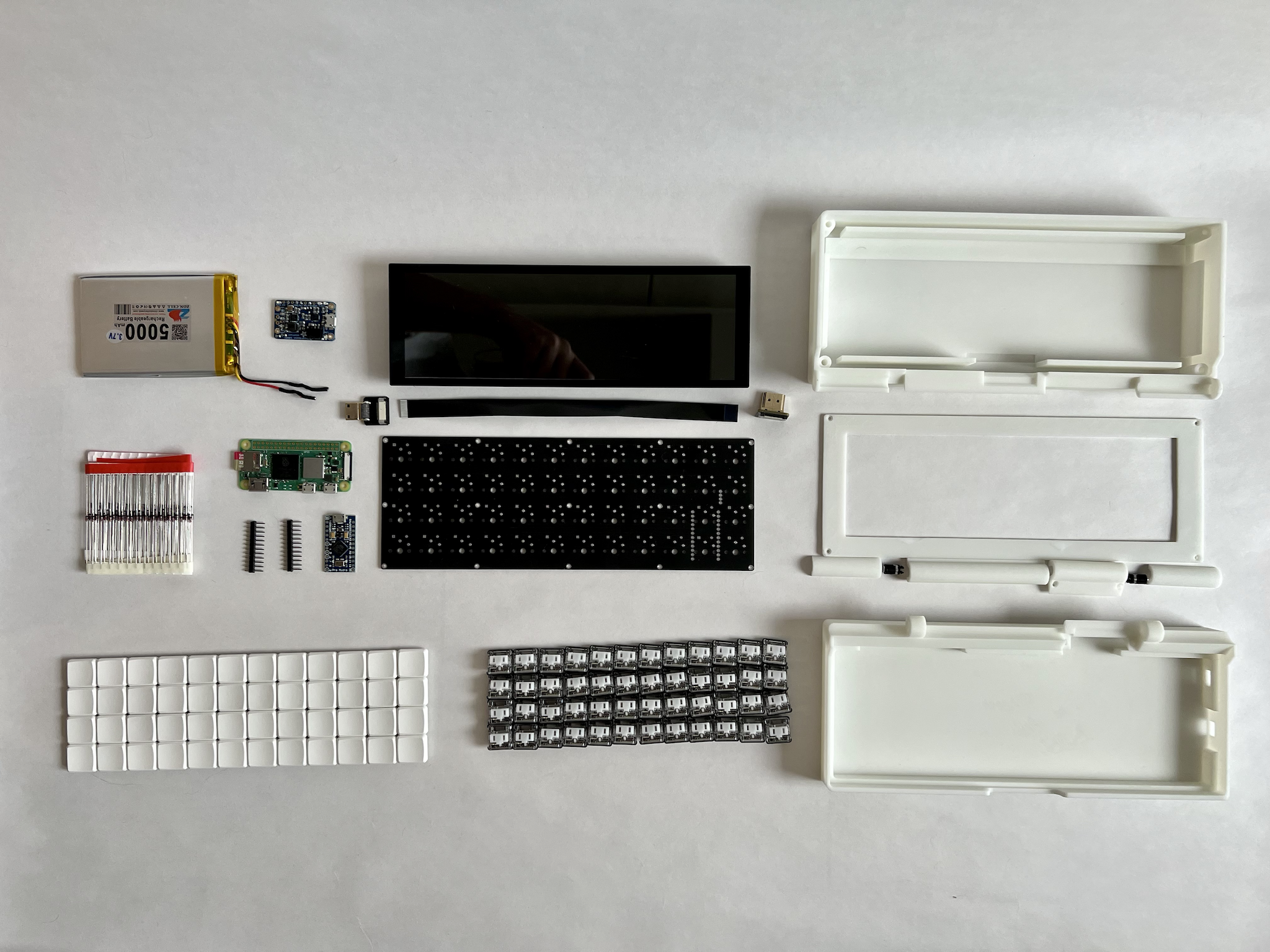
The parts diagram is the strongest single technical reference — clean exploded view of the build, useful for thinking about how KN-86’s custom inset panels (display bezel, OLED bezel, key plate, cart slot, port cutouts) compose.
Notes / open questions for KN-86
Section titled “Notes / open questions for KN-86”- The ultrawide panel proves the genre. A 3.2:1 display works as a personal-computing surface. KN-86’s 1.7:1 is much closer to traditional 4:3; worth noting that we are not committing to ultrawide, but the Penkesu silhouette is part of the same conceptual family.
- Kailh Choc + MBK pairing is a validated combo (in addition to ADR-0024’s own rationale). Penkesu is real-world evidence the switch+cap pairing works at small handheld scale.
- Should KN-86 publish a parts diagram in this style? Penkesu’s parts diagram is more compelling than a wiring schematic for non-engineers — it tells the build story at a glance. Candidate format for the eventual KN-86 hardware reveal.
- The Pelican case decision (canonical hardware spec) is in tension with Penkesu’s “personal-artifact” design language. Pelican reads as tactical / field; Penkesu reads as desktop / domestic. Both are legitimate retro-handheld lineages. Worth being explicit in marketing about which side of that line KN-86 sits on — almost certainly the tactical side (cyberpunk dispatch deck), but acknowledging the other lineage exists.